Paper Abstract
Diffusion models have recently emerged as powerful learners for simulation-based inference (SBI), enabling fast and accurate estimation of latent parameters from simulated and real data. Their score-based formulation offers a flexible way to learn conditional or joint distributions over parameters and observations, thereby providing a versatile solution to various modeling problems. In this tutorial review, we synthesize recent developments on diffusion models for SBI, covering design choices for training, inference, and evaluation. We highlight opportunities created by various concepts such as guidance, score composition, flow matching, consistency models, and joint modeling. Furthermore, we discuss how efficiency and statistical accuracy are affected by noise schedules, parameterizations, and samplers. Finally, we illustrate these concepts with case studies across parameter dimensionalities, simulation budgets, and model types, and outline open questions for future research.
Generative Models at a Glance
At their core, generative models learn to transport a simple base distribution (noise) into a complex target such as a Bayesian posterior. The animations below contrast four families used for simulation-based inference. Diffusion and flow-matching models follow a learned trajectory from noise to target, consistency models jump there in one or a few steps, and normalizing flows transform the distribution through a stack of invertible layers.
Diffusion (reverse SDE)
Flow Matching (reverse ODE)
Consistency Model
Normalizing Flow
Why learn the score?
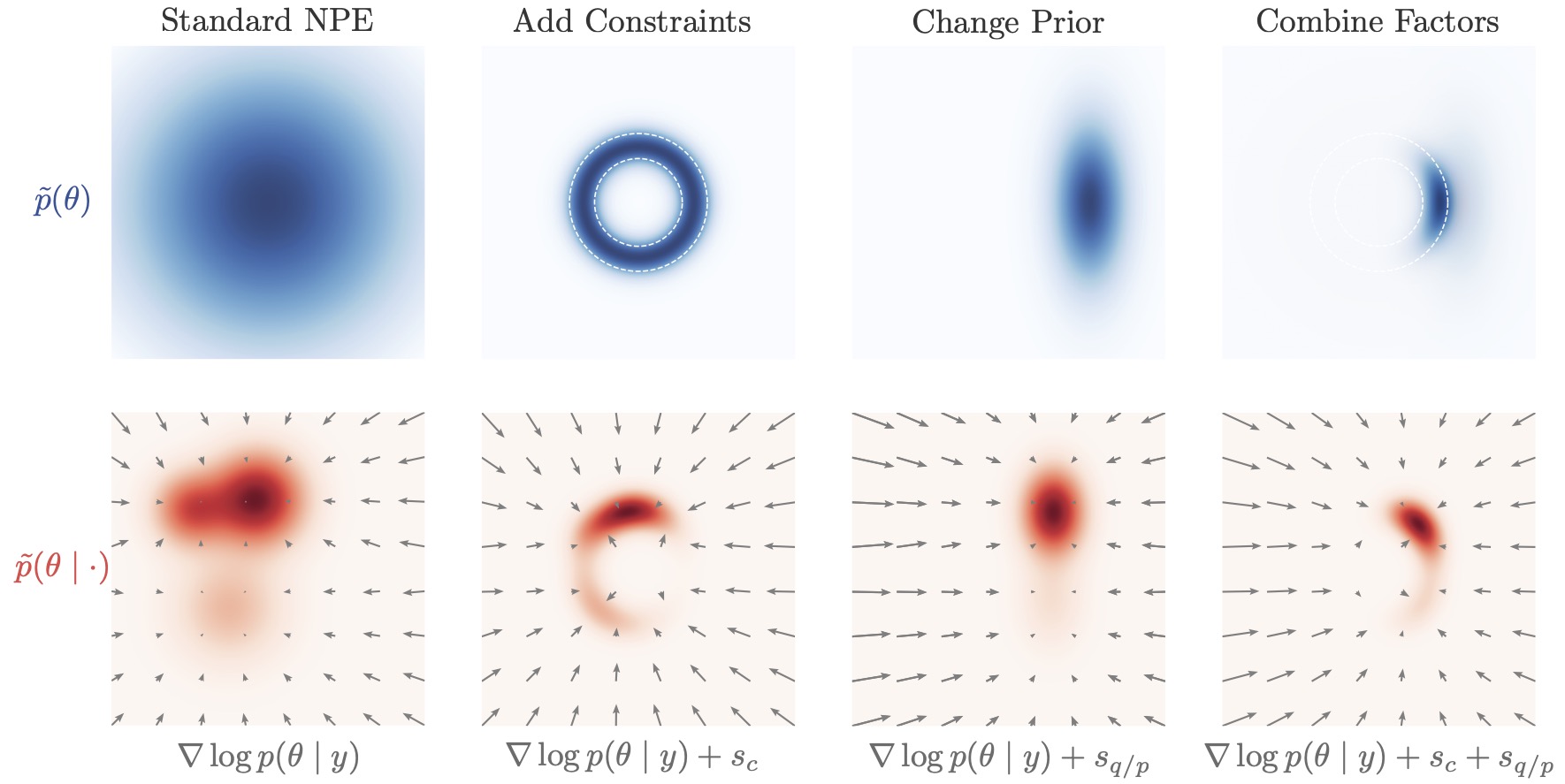
The score, the gradient of the log-density, ∇ log p(θ | y), is pointing toward regions of high posterior probability. Learning this score buys a powerful property: distributions compose by adding their scores. At inference time we can add extra score terms to impose constraints, swap in a new prior, or combine independent factors — all without retraining the model.
The Garden of Design Choices
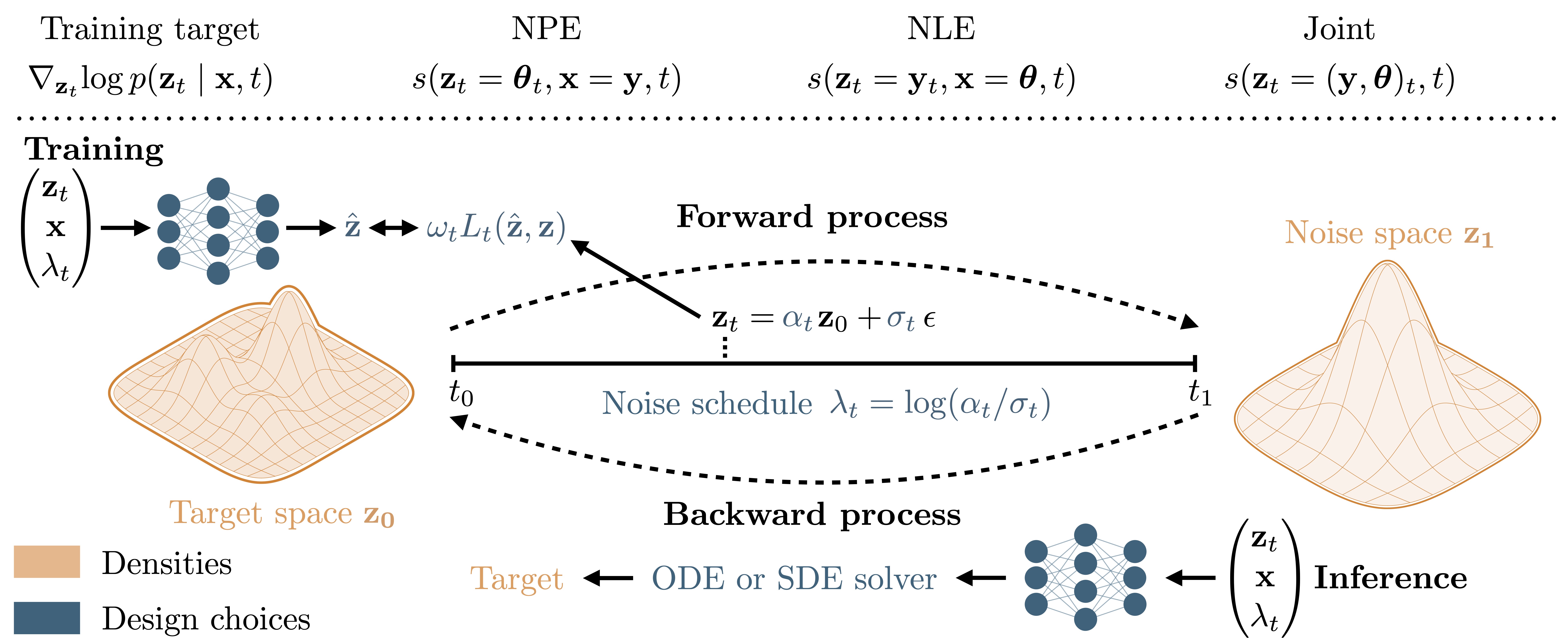
Building a diffusion model for SBI involves a lot of decisions, and each one opens further branches. What should the model estimate — a posterior (NPE), a likelihood (NLE), or the joint distribution? How is noise added over time, and how is the network parameterized and its loss weighted during training? And which ODE or SDE solver should generate samples at inference? Our review maps this garden of design choices and shows how each choice shapes the trade-off between efficiency and accuracy.
Benchmarking
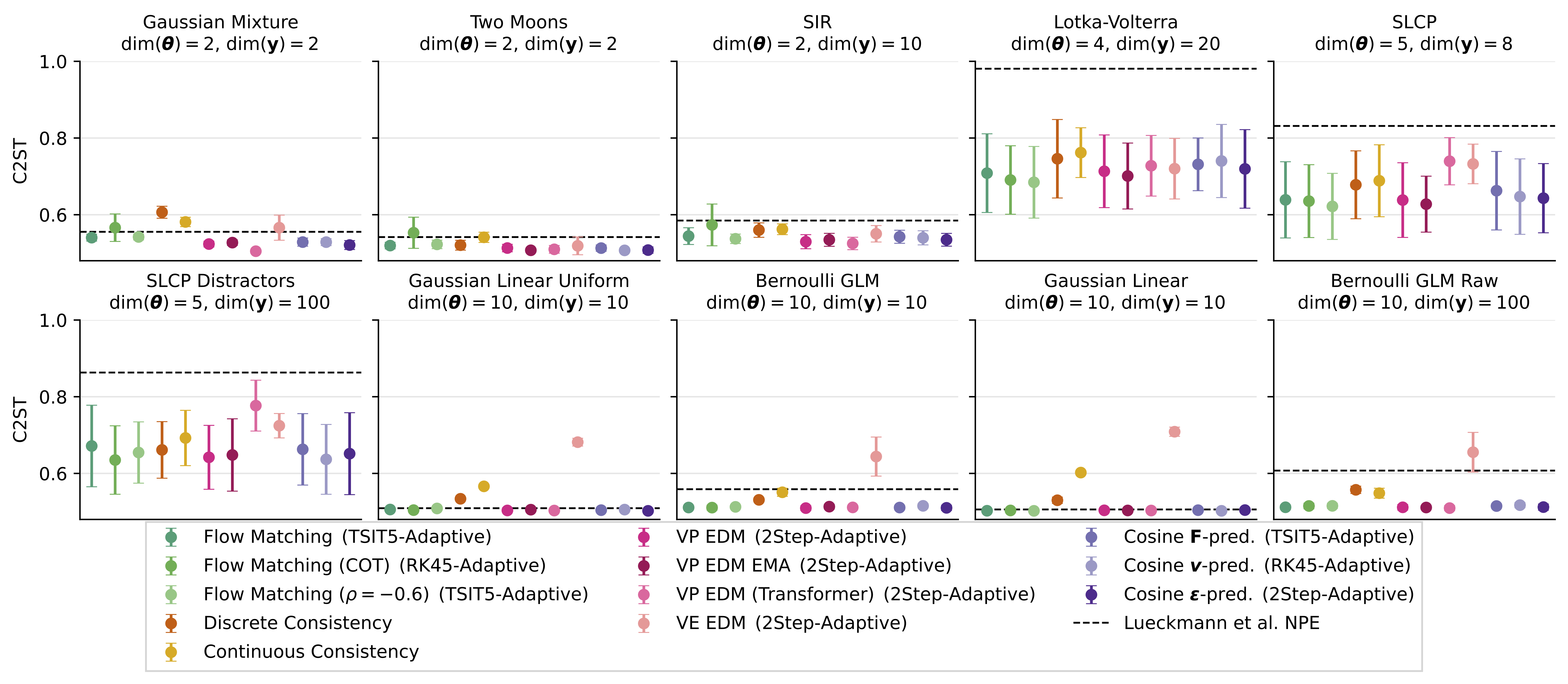
Which design works for which problem? We benchmark the main design choices across multiple settings, showing here the low-dimensional case: ten SBI tasks reporting classifier two-sample test (C2ST) accuracy — where 0.5 means the approximate and true posteriors are indistinguishable. Flow matching and EDM-style diffusion consistently match or outperform a strong NPE baseline, while few-step consistency models trade a little accuracy for much faster sampling.
Tutorial
Citation
@article{arruda2025diffusionSBI,
  title={Diffusion Models in Simulation-Based Inference: A Tutorial Review},
  author={Arruda, Jonas and Bracher, Niels and K{\"o}the, Ullrich and Hasenauer, Jan and Radev, Stefan T},
  journal={arXiv preprint arXiv:2512.20685},
  year={2025},
  url={https://doi.org/10.48550/arXiv.2512.20685}
}